Golf Ball Types and Their Constructions
There are 3 basic types of golf balls on the market today. Let's look at their constructions and what type of golfer should use them to lower his or her total score.
2 Piece Golf Balls:

This type of ball makes up the majority of the market from all the leading manufacturers. It features a large, solid rubber core (shown in blue) surrounded by a plastic or urethane (rubber) cover.
Golf ball engineers can alter the performance of the finished ball by changing the size of core, the compression of the core, and the softness of the cover.
2 Piece Golf Balls are typically your game improvement or distance balls. The large core provides a lot of velocity when struck by the club face.
These balls are typically lower spinning, which means your undesirable slice or hook spin will not be as pronounced and the ball will fly straighter. Lower compression models of 2 piece balls perform well for men, women, and children with slower swing speeds (<85 mph).
3 Piece Hybrid Golf Balls:

Hybrid golf balls have a solid core surrounded
by a "mantle" layer (show in green). This 2 piece assembly is then surrounded by a soft plastic
or urethane rubber cover, making it a member of the 3 Piece Golf Balls family. These balls combine the
forgiveness of a 2 piece model, with the increased performance
and spin control
of a 3 piece construction.
Engineers can adjust the core and thin layer to end up with a playable, performance ball for a variety of golfers. They are quite a revolution.
3 or 4 Piece performance Golf Balls:
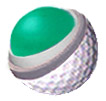
Professional and low handicap golfers with high
swing speeds need a ball with low initial spin (for distance) and
high iron spin (for precision). A 3 or 4 piece golf ball meets these requirements with a unique "dual core" design. The Bryson Dechambeau Golf Swing matches up well with the Bridgestone Tour B X and he is enjoying great success
with that ball.
In a 4 piece construction, the 2 piece core (shown in green and light grey) is surrounded by a thin mantle layer, and then a urethane, dimpled cover. The urethane cover in conjunction with the other components give these balls the "drop and stop" action you see on the weekend broadcasts.
If you still have questions regarding a 3 piece vs 4 piece golf ball for your game, that topic
(with specific ball brands and models) is discussed in more detail
in the free 2020 Golf Ball Reviews guide avaiable on this
page.
Grab
your copy of the 2020
"Golf Ball Guide"
Absolutely FREE!

Now yet's look at your game and determine the right type of ball for you!
Continue To Next Section 